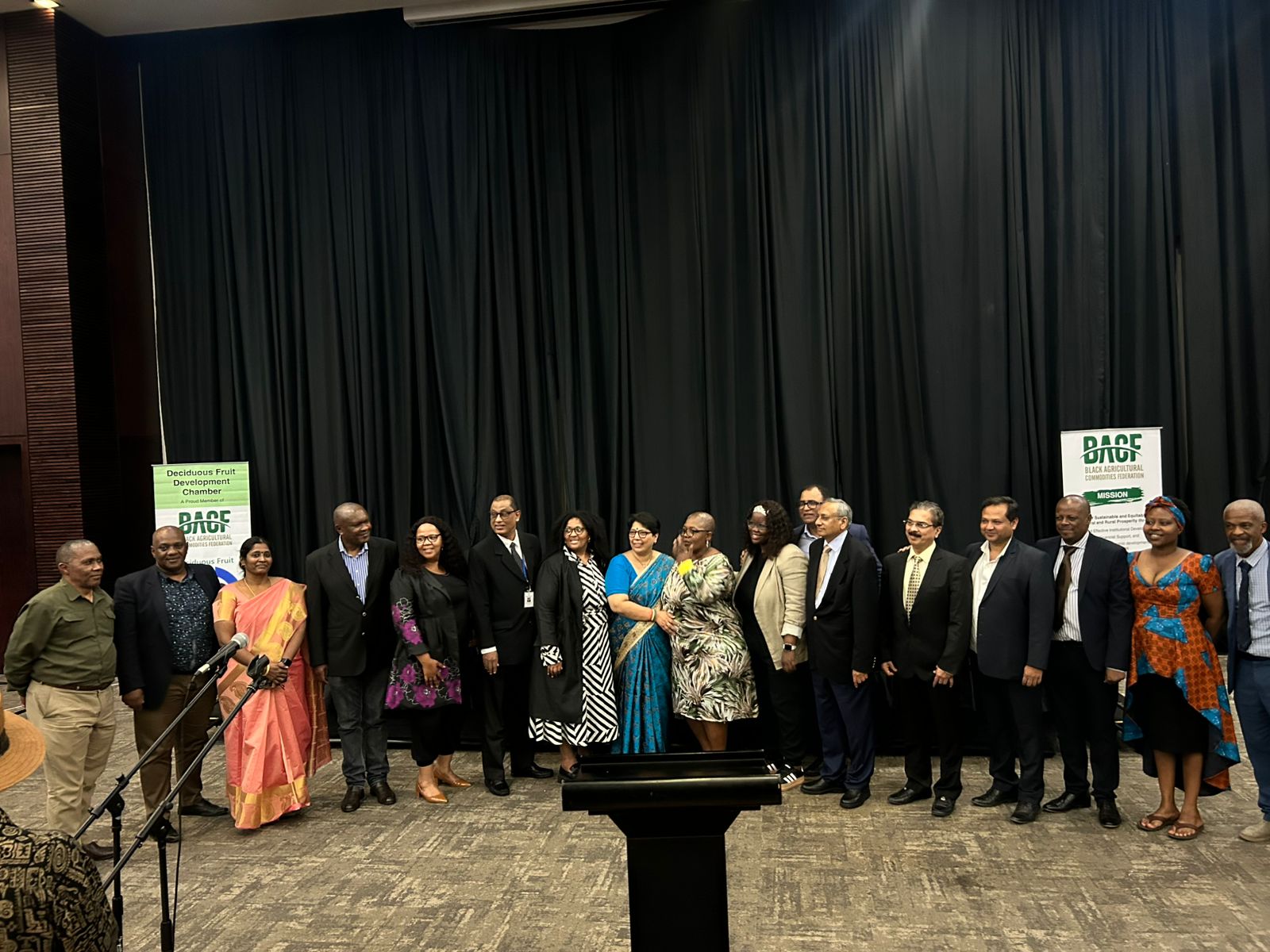
EAST LONDON- The Black Agricultural Commodities Federation (BACF) hosted day one of the high-level Sweet Sorghum and Sugarcane Bioethanol Awareness Workshop on 9 December 2025 at the East London International Convention Centre (EL ICC).
The opening day brought together leading industry organisations for in-depth discussions on the future of South Africa’s bioethanol sector. The two-day workshop brought together international experts, government officials and energy innovators to explore the potential of sweet sorghum and sugarcane as sustainable feedstocks for bioethanol production.

Speaking at the gathering, Minister of Department of Land Reform and Rural Development Mzwanele Nyhontso emphasised that the workshop marked just the beginning of a new era in agricultural development.
“This is not the last workshop, but the first,” he declared, announcing plans for a follow up event that would foster collaboration between the department and farmers.

He urged farmers to aim higher stating that, “You can’t remain small-scale farmers at some point you must transition to commercial farming. The department cannot continue to support those with only small-scale operations,” he said, directing his message to the farming community.
Furthermore, the Director for Agronomy Globally for MAP Micro, one of the leading company listed in the FOS 200s Dr Bhushan Gosavi, stated that their satellite monitoring and sustainable agronomy practices are poised to double the income of small farmers and industries.
“We are providing powerful insights with 95% accuracy, including land type, fertility, organic carbon availability and irrigation schedules through our smart EID scheduler,” he said.

He continued explaining that these insights enable comprehensive crop monitoring and sustainable agronomical practices, leveraging satellite input, imaging, spectral images and hyperspectral images.
“Our technological transfer and potential collaborations are key drivers for this initiative, aiming to empower farmers and industries with data-driven decisions,” Dr Gosavi emphasised.
Furthermore one of the attendees Enoch Somtsorha from Nxarhuni village aknowledged the workshop for providing valuable insights into sweet sorghum production, shared by international experts. He emphasized that, “What makes it interesting is that planting sweet sorghum does not require many things and the benefits is that it produce many things like petrol, sweets and juice.”

In addition a corn farmer from Tsomo Bongani Makalala added citing its potential to double his income compared to corn. He believes sweet sorghum can bring wealth to South Africa and thanked the workshop for providing valuable knowledge on its cultivation.

The workshop was seen as a strategic step towards positioning South Africa as a leader in biofuel production in Africa, diversifying renewable energy sources, and creating inclusive value chains that benefit industry and local communities.
Furthermore Managing Director of National Sugar Institute Kanpur, Professor Seema Paroha highlighted that there are many opportunities for growth in South Africa’s sweet sorghum and sugarcane sectors.
“We will be giving the package of practices on how to grow sugarcane and sweet sorghum so that way people will be aware of the two crops and how they can take them forward.”

In addition Paroha emphasised that sweet sorghum grain can be used for ethanol purposes and the whole stock can be used for the biofuel purpose.
The purpose of the workshop was to help people to have knowledge about sweet sorghum and revive sweet sorghum farming in South Africa and promote sustainable biofuel production.
Photographs:supplied